Xevraniq
Slate Collection
Slate Collection
Couldn't load pickup availability
1. Problem Statement
Cybersecurity reviews often produce many notes, screenshots, timelines, file references, and account details. When these materials are recorded without a common structure, important information can become difficult to locate or compare. Different people may describe the same event using inconsistent wording, which can create confusion during later review. Action points may also remain unclear when observations, responsibilities, and follow-up steps are placed in one long document. Learners need a reliable method for organizing findings without removing context or adding unsupported conclusions.
2. Solution
Slate Collection presents a structured approach to documenting cybersecurity findings from the first observation through the final review note. Learners study how to group information by event, identity, account, file, time, and required action. Each module contains writing exercises, case records, and practical documentation tasks. The course also explores how different document formats can serve different purposes, from brief activity notes to detailed case summaries. Learners develop a repeatable process for preparing records that are clear, useful, and suitable for later examination.
3. What’s Inside
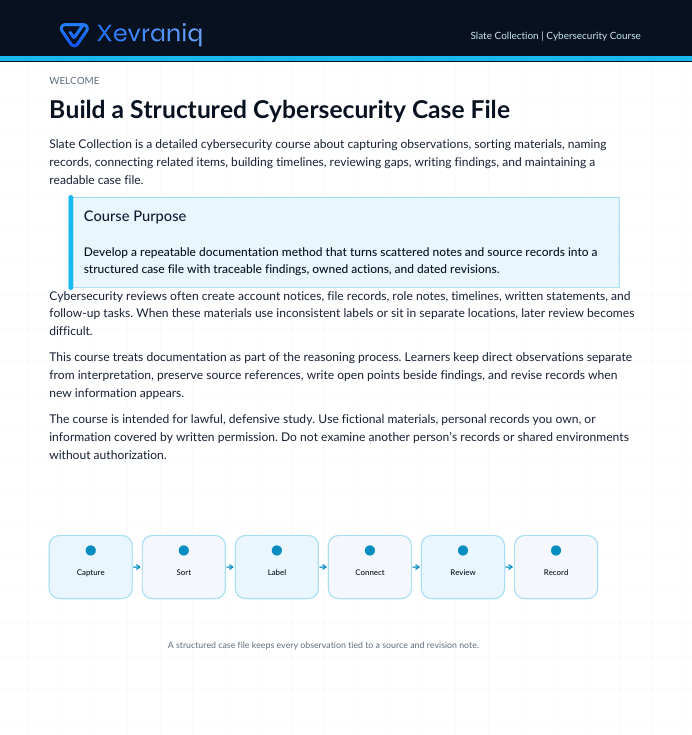
The opening module introduces the slate method: Capture, Sort, Label, Connect, Review, and Record. Learners examine how raw observations can be organized without changing their original meaning. A guided exercise begins with an unstructured set of notes and shows how to divide them into clear categories.
The capture module focuses on recording what was observed, when it occurred, where it appeared, and who reported it. Learners practise writing neutral descriptions that avoid emotional wording and premature conclusions. Examples compare vague notes with more detailed records.
The sorting module examines how information can be grouped by timeline, account, person, file, request, or event type. Learners review several case files and select an organizational method that fits the available information. Worksheets provide space for confirmed facts, open questions, and follow-up actions.
The labeling module covers file names, document titles, version dates, case references, and status markers. Learners develop naming rules that make records easier to review and reduce confusion between earlier and revised documents.
The connection module explores how separate observations may relate to one another. Learners compare timing, identity details, file movement, account changes, and communication patterns. Activities focus on documenting these connections while clearly marking areas where the relationship remains uncertain.
The review module introduces a practical editing process. Learners check whether each record includes context, dates, sources, actions taken, and unanswered questions. They also examine whether sensitive details have been included unnecessarily.
The final project presents a fictional cybersecurity case containing activity notes, file records, account notices, and written statements. Learners prepare an organized case file, build a timeline, identify missing details, and write a structured review summary.
Course materials include documentation templates, review sheets, naming guides, case records, timeline pages, action trackers, terminology notes, and reflection prompts.
4. Who Is This For?
Slate Collection is intended for learners who want to improve cybersecurity documentation and case organization. It may suit students, coordinators, administrators, independent workers, and team members responsible for recording unusual digital activity. No technical background is required, though familiarity with basic cybersecurity ideas may be useful.
5. What You’ll Learn
- Record cybersecurity observations in neutral language
- Separate confirmed facts from open questions
- Organize case materials by time, identity, account, or event
- Create consistent file and document names
- Build readable timelines from scattered notes
- Connect related observations without unsupported conclusions
- Prepare action lists with clear responsibilities
- Review records for missing context
- Reduce unnecessary sensitive details in documentation
- Write structured case summaries
- Maintain clear versions of revised documents
- Prepare materials for later internal review
6. 30-Day Refund Policy
Refund requests for Slate Collection may be submitted within 30 days of purchase. Each request is reviewed under the terms displayed on the Xevraniq store policy page during checkout. Learners should read those terms before placing an order, including any conditions related to completed modules, downloaded materials, or course usage.
Self-paced learning overview
- 📥 Digital file available after purchase
- ♾️ Long-term availability
- 🔒 Secure checkout
- 🗓️ Content updated in 2026
How are the courses organized?
How are the courses organized?
Each Xevraniq course is divided into clear modules with focused topics, guided explanations, practice tasks, and review prompts. The structure allows learners to follow the materials in order or revisit selected topics when needed.
Can I study at my own pace?
Can I study at my own pace?
Yes. The materials are designed for self-paced study, so learners can choose a rhythm that fits their schedule. Progress depends on personal study habits, time spent with the materials, and regular practice.
What kind of support is included?
What kind of support is included?
Learners can send course-related questions through the contact form. Replies focus on course structure, topic clarification, and guidance on where to find relevant materials.
Share