Xevraniq
Pulse Collection
Pulse Collection
Couldn't load pickup availability
1. Problem Statement
Digital activity creates a continuous stream of account changes, file movements, messages, verification notices, and permission updates. Individual events may appear ordinary when reviewed without context. Learners may notice unusual activity but struggle to determine whether it belongs to a larger pattern. Irregular documentation can make comparisons difficult, especially when dates, actions, and identities are recorded in different formats. A structured method is needed to examine activity over time without relying on assumptions.
2. Solution
Pulse Collection introduces a practical process for reviewing repeated activity across a defined period. Learners study timing, frequency, identity consistency, action sequences, and changes in normal behavior. Each module uses guided exercises to help organize observations and compare related events. Scenario reviews encourage learners to distinguish isolated activity from patterns that may require further examination. The course supports careful reasoning through written records, timelines, and clearly defined review steps.
3. What’s Inside
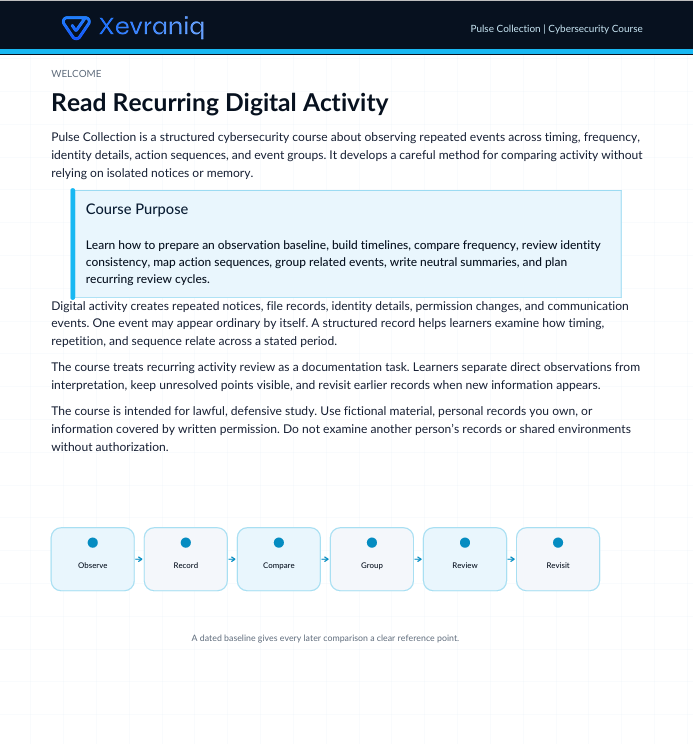
The opening module introduces the pulse review method: Observe, Record, Compare, Group, and Revisit. Learners examine why repeated activity can provide more context than one isolated notice. A guided worksheet helps document events without adding unsupported conclusions.
The timing module focuses on dates, repeated intervals, unusual hours, and clusters of activity. Learners compare several timelines and identify where events appear connected. Exercises also explain why timing alone does not confirm intent and should be reviewed alongside other details.
The frequency module examines repeated requests, account notices, file changes, verification attempts, and communication patterns. Learners practise recording how often an event occurs and whether its frequency differs from earlier behavior.
The identity module covers names, account details, sender information, role descriptions, and unexpected changes. Learners compare records to identify inconsistencies while keeping confirmed facts separate from interpretation.
The sequence module examines the order in which actions occur. Examples include a message followed by an account notice, a permission change followed by file movement, or a role update followed by unusual communication. Learners create event chains and mark where further review may be helpful.
The grouping module shows how related observations can be organized by identity, time, location, account, file, or requested action. Learners compare several grouping methods and choose the one that presents the clearest picture.
The closing case study combines several weeks of fictional activity. Learners build a timeline, group related events, identify missing information, and prepare a neutral review summary.
Course materials include observation logs, timeline sheets, frequency tables, event-chain diagrams, identity review pages, case files, terminology notes, and reflection activities.
4. Who Is This For?
Pulse Collection is intended for learners who want to study recurring digital behavior through organized observation. It may suit students, coordinators, administrators, independent workers, and team members who review account or file activity. No technical background is required, though familiarity with basic cybersecurity ideas may be helpful.
5. What You’ll Learn
- Record recurring digital events in a consistent format
- Build timelines from separate activity records
- Compare frequency across defined periods
- Review identity details for inconsistencies
- Connect related actions through event chains
- Group observations by time, account, file, or behavior
- Separate confirmed information from interpretation
- Identify missing details before preparing conclusions
- Write neutral summaries for internal review
- Revisit earlier records when new information appears
- Develop a recurring activity-review routine
6. 30-Day Refund Policy
Refund requests for Pulse Collection may be submitted within 30 days of purchase. Each request is reviewed under the terms displayed on the Xevraniq store policy page during checkout. Learners should read those terms before placing an order, including any conditions related to completed modules, downloaded materials, or course usage.
Self-paced learning overview
- 📥 Digital file available after purchase
- ♾️ Long-term availability
- 🔒 Secure checkout
- 🗓️ Content updated in 2026
How are the courses organized?
How are the courses organized?
Each Xevraniq course is divided into clear modules with focused topics, guided explanations, practice tasks, and review prompts. The structure allows learners to follow the materials in order or revisit selected topics when needed.
Can I study at my own pace?
Can I study at my own pace?
Yes. The materials are designed for self-paced study, so learners can choose a rhythm that fits their schedule. Progress depends on personal study habits, time spent with the materials, and regular practice.
What kind of support is included?
What kind of support is included?
Learners can send course-related questions through the contact form. Replies focus on course structure, topic clarification, and guidance on where to find relevant materials.
Share