Xevraniq
Lattice Guide
Lattice Guide
Couldn't load pickup availability
1. Problem Statement
Cybersecurity incidents rarely develop from one isolated action. A weak account habit, unclear permission, overlooked message, or poorly handled file can connect with other issues. Learners may understand individual threats while missing the relationships between people, devices, information, and daily routines. Scattered guidance often presents separate rules without explaining how one choice can affect another part of a digital environment. This makes it difficult to review the wider situation and decide where careful changes may be helpful.
2. Solution
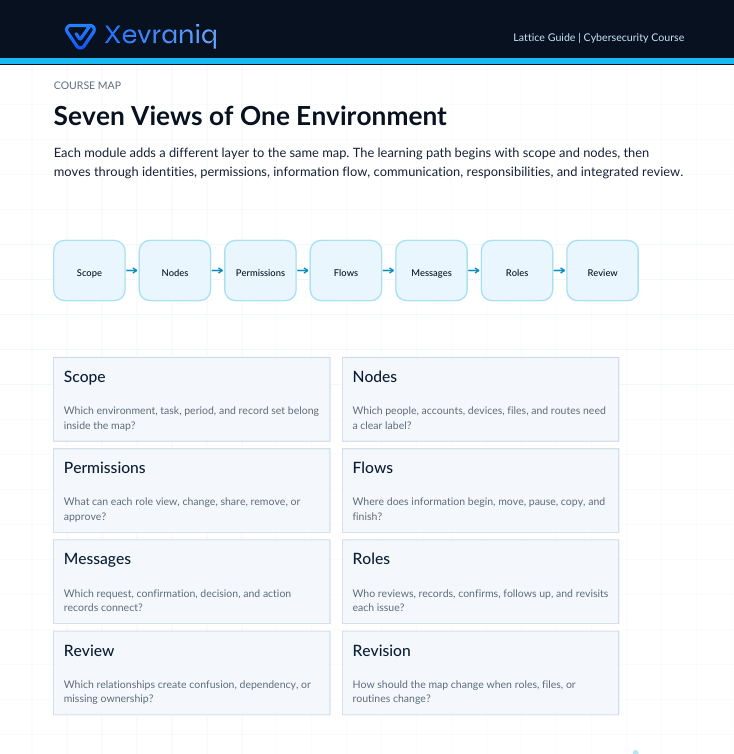
Lattice Guide introduces a connected approach to cybersecurity study. The course shows learners how identities, information, permissions, communication, and routine actions form a wider digital structure. Each module examines one area before linking it with the topics covered earlier. Practical activities encourage learners to map relationships, identify weak points, and consider suitable responses. This approach helps build a detailed understanding of how separate cybersecurity decisions influence one another.
3. What’s Inside
The first module introduces the lattice model, a visual method for examining connections within a digital environment. Learners identify people, accounts, devices, files, communication channels, and permission levels. A guided mapping activity shows how information may move between these elements and where additional review may be useful.
The identity module examines how one person may use several accounts and roles during everyday activities. It covers identity verification, account separation, shared details, recovery methods, and unusual identity-related changes. Scenario tasks ask learners to compare normal behavior with activity that deserves closer attention.
The permissions module explores why different people and accounts may require different levels of control. Learners review broad permissions, outdated roles, shared accounts, and unnecessary authority. A practical worksheet provides a structured method for recording who can view, change, share, or remove selected information.
The information-flow module focuses on how files and sensitive details move through a digital environment. Topics include file sharing, storage choices, repeated copies, unclear ownership, and information sent to the wrong recipient. Learners create simple flow diagrams and mark points where careful handling matters.
Another module examines human decisions and communication habits. It covers unexpected requests, unclear instructions, identity confusion, repeated pressure, and situations where people act before reviewing available details. Learners practise pausing, checking context, confirming information through an appropriate channel, and documenting concerns.
The final section combines all course topics in several detailed case studies. Each case includes identities, permissions, information movement, and communication choices. Learners review the full situation, identify connected concerns, and prepare a written improvement plan. Supporting materials include diagrams, review sheets, terminology notes, knowledge checks, and reflection prompts.
4. Who Is This For?
Lattice Guide is intended for learners who want to understand cybersecurity as a connected field rather than a collection of isolated rules. It may suit students, independent professionals, team members, coordinators, and people who regularly handle digital information. Prior technical study is not required, although familiarity with basic cybersecurity terms may be helpful.
5. What You’ll Learn
- Map relationships between identities, accounts, devices, and information
- Review permissions using a structured worksheet
- Identify unnecessary authority and unclear account roles
- Trace how files and sensitive details move between people
- Recognize connections between human decisions and technical concerns
- Compare normal activity with behavior requiring further review
- Separate isolated warning signs from wider patterns
- Document observations using diagrams and written notes
- Prepare practical improvement plans for common digital situations
- Apply connected thinking during future cybersecurity study
6. 30-Day Refund Policy
Refund requests for Lattice Guide may be submitted within 30 days of purchase. Each request is reviewed under the terms displayed on the Xevraniq store policy page at checkout. Learners should read those terms before placing an order, including any conditions related to completed modules, downloaded materials, or course usage.
Self-paced learning overview
- 📥 Digital file available after purchase
- ♾️ Long-term availability
- 🔒 Secure checkout
- 🗓️ Content updated in 2026
How are the courses organized?
How are the courses organized?
Each Xevraniq course is divided into clear modules with focused topics, guided explanations, practice tasks, and review prompts. The structure allows learners to follow the materials in order or revisit selected topics when needed.
Can I study at my own pace?
Can I study at my own pace?
Yes. The materials are designed for self-paced study, so learners can choose a rhythm that fits their schedule. Progress depends on personal study habits, time spent with the materials, and regular practice.
What kind of support is included?
What kind of support is included?
Learners can send course-related questions through the contact form. Replies focus on course structure, topic clarification, and guidance on where to find relevant materials.
Share