Xevraniq
Arc Collection
Arc Collection
Couldn't load pickup availability
1. Problem Statement
Cybersecurity situations often involve several connected issues rather than one isolated warning sign. An unusual message may relate to an account change, a permission update, a moved file, or an unclear responsibility. Learners who study these topics separately may find it difficult to combine them during a detailed review. Missing records and inconsistent procedures can make the wider sequence harder to understand. A broader study path is needed to connect observations, timelines, roles, information movement, and response steps.
2. Solution
Arc Collection presents a unified method for examining complex digital situations. Learners combine mapping, timeline building, identity review, permission checks, documentation, and response planning. Each module adds a new layer to the same fictional environment, allowing earlier observations to be reconsidered as new details appear. Guided activities encourage learners to record facts, mark uncertainty, and explain the reasoning behind each decision. The course concludes with a detailed case project that brings every study area into one organized review.
3. What’s Inside
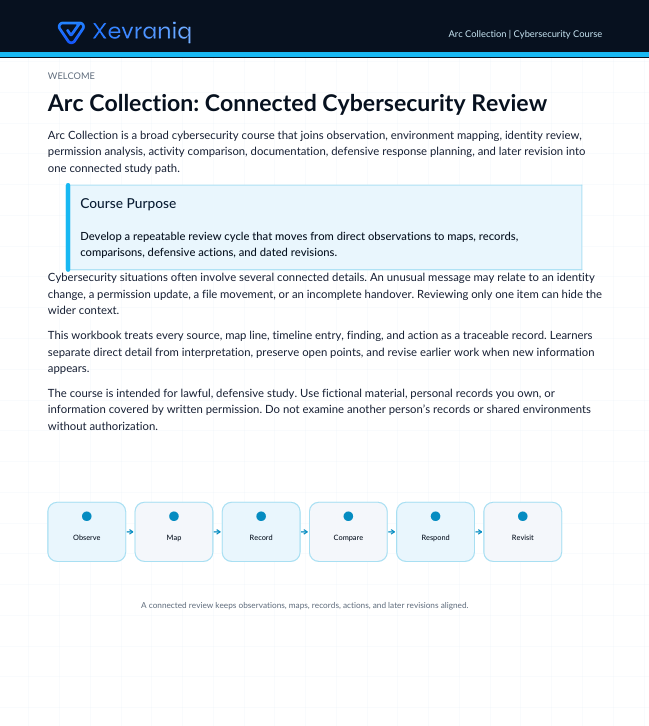
The opening module introduces the Arc Review Cycle: Observe, Map, Record, Compare, Respond, and Revisit. Learners begin with a fictional digital environment containing accounts, shared files, communication routes, assigned roles, and routine activity. A workbook helps organize each element before any conclusions are written.
The mapping module examines relationships between people, accounts, devices, files, permissions, and responsibilities. Learners create a visual structure showing how information moves and where unclear connections may require closer review.
The activity module focuses on timing, frequency, identity details, and action sequences. Learners build timelines from account notices, communication records, file changes, and written statements. They then compare ordinary routines with events that differ from earlier patterns.
The documentation module covers neutral note-taking, file naming, evidence logs, case references, and version tracking. Learners practise separating direct observations from interpretation and listing unanswered questions beside confirmed details.
The permission and responsibility module examines who can view, change, share, or remove information. Activities include role comparison, outdated permission review, responsibility mapping, and follow-up planning.
The response module presents situations involving suspicious requests, unfamiliar account activity, misplaced files, and unclear instructions. Learners prepare written response paths that include confirmation steps, documentation points, responsible contacts, and later review.
The closing project contains a detailed case file with several connected events. Learners create an environment map, prepare a timeline, compare identity and permission details, organize supporting records, and write a structured review report. They also prepare a practical action plan and explain which observations require further examination.
Included materials feature mapping sheets, timeline pages, evidence logs, permission tables, responsibility charts, case files, terminology references, review prompts, and written assessment tasks.
4. Who Is This For?
Arc Collection is intended for learners seeking a broad and detailed cybersecurity study path. It may suit students, coordinators, administrators, independent workers, team members, and people responsible for reviewing digital information or documenting unusual activity. Prior study of basic cybersecurity concepts may be helpful, though each module includes contextual explanations.
5. What You’ll Learn
- Connect account, file, identity, and communication observations
- Create detailed maps of digital environments
- Build timelines from separate activity records
- Review permissions and assigned responsibilities
- Organize case materials using consistent documentation methods
- Separate confirmed facts from assumptions
- Compare current behavior with earlier routines
- Prepare written response paths for common concerns
- Identify missing details before forming conclusions
- Write structured cybersecurity review reports
- Develop practical action plans
- Revisit earlier findings when new information appears
6. 30-Day Refund Policy
Refund requests for Arc Collection may be submitted within 30 days of purchase. Each request is reviewed under the terms displayed on the Xevraniq store policy page during checkout. Learners should read those terms before placing an order, including any conditions related to completed modules, downloaded materials, or course use.
Self-paced learning overview
- 📥 Digital file available after purchase
- ♾️ Long-term availability
- 🔒 Secure checkout
- 🗓️ Content updated in 2026
How are the courses organized?
How are the courses organized?
Each Xevraniq course is divided into clear modules with focused topics, guided explanations, practice tasks, and review prompts. The structure allows learners to follow the materials in order or revisit selected topics when needed.
Can I study at my own pace?
Can I study at my own pace?
Yes. The materials are designed for self-paced study, so learners can choose a rhythm that fits their schedule. Progress depends on personal study habits, time spent with the materials, and regular practice.
What kind of support is included?
What kind of support is included?
Learners can send course-related questions through the contact form. Replies focus on course structure, topic clarification, and guidance on where to find relevant materials.
Share